Chronic Pain
Zhittya Genesis Medicine is developing FGF-1 to treat chronic and neuropathic pain at its source — by regenerating injured nerves, calming the neuroinflammation that keeps pain switched on, restoring blood flow to oxygen-starved nerve tissue, and protecting the cellular energy supply that failing neurons depend on. It is a non-opioid candidate designed to modify the disease rather than simply mask the signal.
An estimated 50 million-plus Americans live with chronic pain, and roughly one in five U.S. adults is affected — a rate that now exceeds diabetes, depression, or high blood pressure. The therapies most patients are offered (opioids, NSAIDs, anticonvulsants, antidepressants) act on the perception of pain without addressing the injured tissue that produces it, which is why relief is partial and, with opioids, carries a crisis of dependence.
FGF-1 is one of the most potent known stimulators of angiogenesis, and Zhittya's management has invested over $190 million advancing the molecule through US FDA Phase IIA/IIB clinical trials across multiple indications, with an existing human safety foundation and an intranasal delivery route already in clinical use for neurological conditions. That same platform is mechanistically matched to the biology of chronic pain.
The Science: How FGF-1 Targets Pain
Recent research reframes chronic pain as a self-reinforcing cycle operating at the level of the individual cell: nerve injury and metabolic stress raise reactive oxygen species and disrupt the mitochondria inside sensory neurons, which sensitizes pain-sensing neurons and activates the surrounding glial cells, releasing inflammatory mediators that injure neurons further. The published literature documents FGF-1 acting on every node of that cycle — something no single conventional analgesic does.
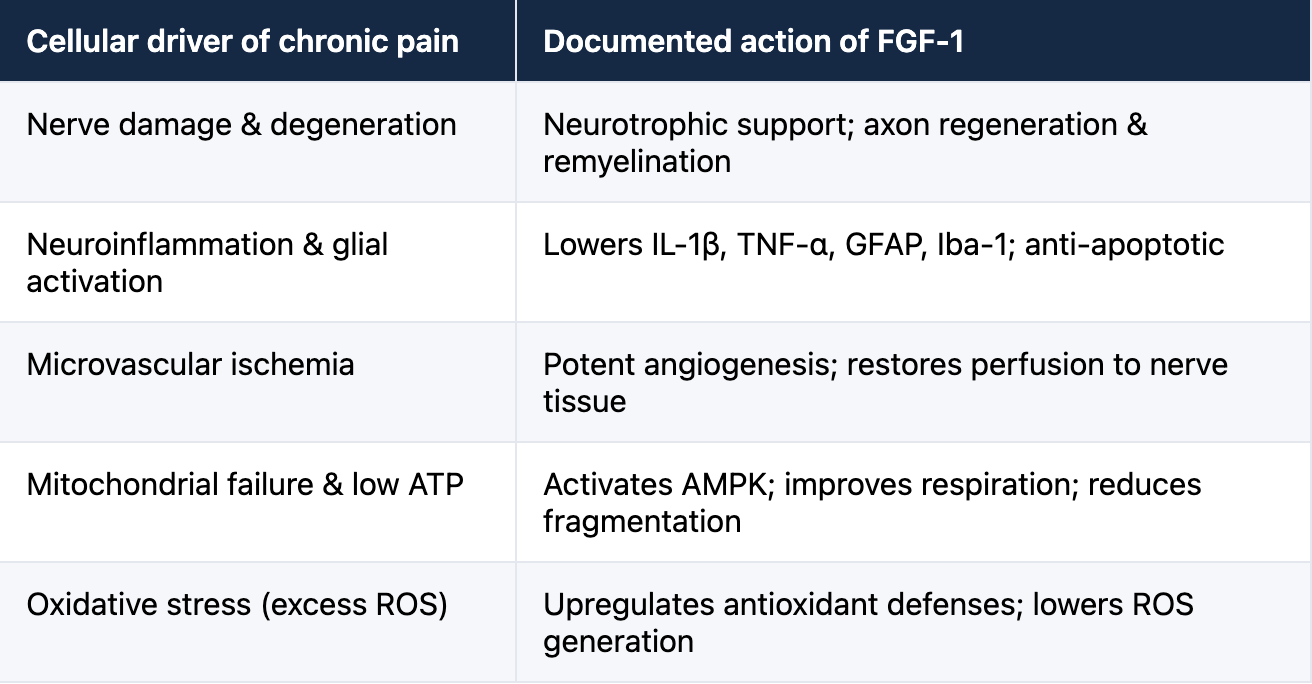
In chronic constriction injury models — a standard model of neuropathic pain — cells engineered to express FGF-1 reduced both mechanical and thermal hypersensitivity, while saline did not, lowering markers of cell death and neuroinflammation in the spinal cord. Researchers concluded FGF-1 could be a promising treatment for neuropathic pain.
History
FGF-1 is a potent stimulator of angiogenesis — the growth of new blood vessels — capable of growing new blood vessels in ischemic areas of the body, including the brain. In a US FDA Phase IIA clinical trial conducted at the University of Cincinnati, the drug grew new blood vessels in the hearts of patients with coronary artery disease, improving many of their symptoms, with the results reported by ABC Nightly News. The molecule has since been studied across diabetic foot ulcers, stroke recovery, and Parkinson's disease.
Zhittya's clinical work to date has concentrated on central-nervous-system applications — most prominently Parkinson's disease via intranasal delivery, where patient data have shown meaningful motor improvement over roughly six months alongside imaging evidence of increased cerebral blood flow. That experience demonstrates in humans that FGF-1, delivered non-invasively, can produce functional improvement on a months-long timescale consistent with a regeneration-and-reperfusion mechanism — exactly the kind of repair a chronic-pain program is designed to measure. The chronic pain program is currently at the preclinical and translational stage, building on this existing human safety and delivery foundation.
Chronic Pain White Paper
Register for Medical Research Studies for Chronic Pain:
If you have chronic pain and are interested in potentially participating in our medical research study to treat chronic pain, complete the form below to express your interest. For those patients that are selected to participate, they will bear no cost for participating in the study other than their own travel and accommodations. This is a voluntary medical research study to evaluate FGF-1's ability to potentially treat chronic pain. We'll screen applicants for eligibility, but there's no guarantee of participation or specific results. All processes follow ethical guidelines, including informed consent.
Disclaimer: This form is for expressing interest in a medical research study only. It does not constitute enrollment, medical advice, or a guarantee of participation. All studies comply with FDA guidelines and ethical standards. Consult your physician before considering any research involvement.